Destination guide
Antalya: the south coast hub worth more than a transfer
Most people fly into Antalya and drive straight out. The old town, the ruins within an hour, and the coast road west all argue for staying.
- 2–4 nightsTime to give it
- KaleiçiWhere to stay
- AYTAirport
- May–OctSwimming season
Why stay rather than transfer straight out
Antalya airport handles a vast volume of package traffic, and most of it is on a coach within forty minutes of landing. That is a reasonable way to get to a resort and a poor way to see the city, because Antalya has the one thing most Turkish coastal towns lack: a genuine old quarter.
Kaleiçi sits inside the old walls above a Roman harbour — narrow lanes, Ottoman houses, Hadrian's Gate at the entrance, and enough restaurants and small hotels to make it a base rather than a stop. Add the Antalya Museum, which holds some of the best Roman sculpture in the country, and you have two days without leaving the city.
Where to stay
- Kaleiçi (old town)
- Restored Ottoman houses turned into small hotels, inside the walls, walking distance to the harbour and the museum. The best choice for a city stay.
- Konyaaltı
- Modern apartments and hotels along the western beach, with the mountains behind. Good if you want to swim daily and still reach the centre easily.
- Lara / east
- Where the large all-inclusive resorts are. Sand rather than pebble, and a taxi from anything resembling a town.
One practical note for Kaleiçi: it is cobbled and partly pedestrianised. Wheeled luggage is hard work, and drivers often cannot get to the door.
The beaches
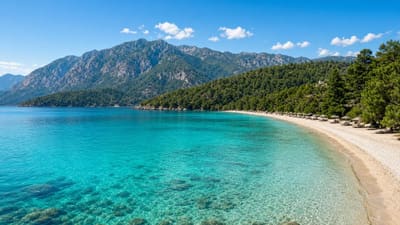
Konyaaltı is the city beach — a long pebble stretch with the Beydağları mountains rising straight out of the sea behind it, which is the view that makes it. Facilities are good and it is reachable by tram.
Lara, east of the city, is sandy and is where the resort strip runs. Better for families who want sand underfoot, worse if you want to be able to walk somewhere for dinner.
For something better than both, the beaches an hour west towards Çıralı and Olympos are where the coast starts to look like the photographs — a long quiet shore backed by ruins and pine.
Ruins and day trips
This is Antalya's real argument. Within roughly an hour:
- Aspendos — a Roman theatre so intact it still hosts performances. The single most impressive ancient structure on this coast.
- Side — a seaside town built among ruins, with a temple of Apollo on the point. Touristy, and still worth it at sunset.
- Termessos — a mountain city the Romans never took, reached by a steep walk through pine forest. Far less visited than it deserves.
- Perge — a huge, flat, easily walked Roman site with a colonnaded street, closest to the city.
- Olympos and the Chimaera — ruins in a river valley, plus natural flames that burn out of the hillside after dark.
- Düden Waterfalls — the lower falls drop straight into the sea; the upper falls are a city park.
If you only do one: Aspendos in the morning, Side in the late afternoon. They sit on the same road east and combine into one very good day.
Heading west along the coast
The road west from Antalya towards Kaş and Fethiye is the Turquoise Coast proper — cliffs, pine, and water that earns the name. It is also slow, winding and genuinely beautiful, which makes it a drive worth doing in daylight rather than a transfer to sleep through.
Kaş at around three hours is the usual next base: a small harbour town with diving, sea kayaking over a sunken city at Kekova, and none of the resort scale. Push on and you reach Fethiye and Ölüdeniz, and eventually Marmaris and the boat-trip coast.
This stretch is also the start of the Lycian Way, a long-distance waymarked trail running along the coast. You do not need to walk all of it — individual day sections out of Kaş or Çıralı are among the best walking in Turkey.
Common questions
Is Antalya worth visiting, or just a transfer airport?
Worth visiting. Kaleiçi — the walled old town above the Roman harbour — is a genuine old quarter rather than a reconstructed one, and some of Turkey's best-preserved Roman sites are within an hour's drive. Two nights is enough to justify it; four if you want the ruins and the beaches properly.
When can you swim in Antalya?
The sea is comfortable from roughly May to October, and warmest in August and September. July and August are very hot inland and busy on the coast. Late September and early October are the sweet spot: warm water, thinner crowds, bearable temperatures for walking around ruins.
Konyaaltı or Lara beach?
Konyaaltı is pebble, west of the centre, backed by mountains and walkable from the city. Lara is sand, east of the centre, and is where most of the big resorts are. For a city stay, Konyaaltı is the easier choice.
How do you get from Antalya airport to the city?
The tram runs from the airport towards the centre, and the airport bus and taxis cover the same route in about half an hour. If you are heading straight to a resort further along the coast, a pre-booked transfer usually makes more sense than the public options.
Is Antalya a good base for the Turquoise Coast?
For the eastern half, yes — Side, Aspendos, Olympos and Termessos are all day trips. For Kaş, Fethiye and Ölüdeniz you are looking at three to four hours each way, so those deserve their own base rather than a day trip.
Last reviewed September 2026. Prices, visa rules and opening times change — check official sources before you book.
Keep planning