Tours
Pamukkale tours: day trip from the coast, or stay the night
The white terraces photograph well from a coach window. They are a better place if you arrive late, walk them at the quiet end of the day, and sleep below the ridge.
- OvernightBest if you can
- DenizliClosest city
- HierapolisThe ruins on the ridge
- Shoes offOn the terraces
Day trip vs overnight
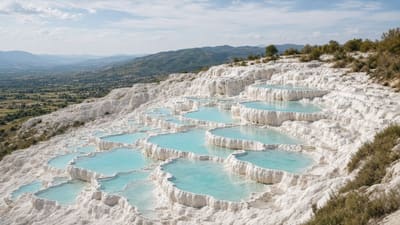
Overnight wins if Pamukkale is more than a box on a coach itinerary. The terraces are a ridge of calcium carbonate above a working village. Hierapolis — the Roman spa city — sits on top of that ridge. You need time on both, and you need them when the light is low and the groups are not standing in your photograph.
A day trip can still be rational. You are already in Kuşadası or Antalya, you have one spare day, and you would rather see the white hillside than skip it. That is an honest trade: you will spend more time in a seat than on the calcium, you will walk it in the heat, and you will be back at the hotel in time for a late dinner you barely want. Fine. Do not pretend it is the same visit as sleeping underneath the ridge.
The Pamukkale guide is the place for how the site fits a wider loop. This page is the logistics: where the tour starts, what it actually includes, and when you should refuse the combined ticket.
The combined-tour trap: Ephesus in the morning, Pamukkale in the afternoon, hotel after dark. You will remember the coach more than either ruin. If you care about both, give Ephesus its own day and Pamukkale a night.
From Denizli, Kuşadası, Antalya
- Denizli
- The nearest city, about twenty to thirty minutes by road. Independent visit, not a “tour” in any meaningful sense. Stay in Pamukkale village rather than Denizli unless you have a train or bus to catch.
- Kuşadası / Selçuk
- Three to three and a half hours each way. The usual origin for Aegean package guests. Sensible as a dedicated day; grim as a bolt-on after Ephesus.
- Antalya
- Roughly three hours inland, depending on the D650 and the heat. A long day from Kaleiçi. Better if you are already heading north, worse if you have to return the same evening.
- İzmir
- Similar distance to Kuşadası, sometimes cheaper tours because of the volume. Same caveat: it is a travel day with a walk in the middle.
From Denizli you do not need a guide. Minibuses run to Pamukkale village; a taxi to the south gate is straightforward. You walk up through the terraces (shoes off on the calcium, in the designated channels) and come down through Hierapolis, or you enter at the north gate, do the ruins first, and descend the white slope at the end — which is the more pleasant direction in summer, because the downhill walk is the photogenic one and you are not climbing it at noon.
From the coast, a named operator with a small group beats a forty-seat coach that also stops at a carpet shop. Read the itinerary for two things: how long you are actually on site (under two hours is a photo stop), and whether Hierapolis is included or treated as optional. The ticket is for the whole archaeological park. A tour that “does the travertines” and skips the theatre is wasting the money you already paid at the gate.
Terraces and Hierapolis
The white hillside is travertine: mineral water, evaporated, stacked in frozen waterfalls. You are not meant to wander the whole face. Paths are marked, much of the calcium is closed to feet, and the turquoise pools you see in older photographs are not all still for swimming. Bring flip-flops you can carry, a hat, and more water than looks dignified. The stone reflects heat. In July and August the climb is the hard part of the day, not the history.
Hierapolis is why the overnight is worth it. A Roman theatre with the valley behind it, a long colonnaded street, the Frontinus Gate, a huge necropolis, and the sense of a spa city that used this water two thousand years before Instagram. Walk it in the late afternoon. The coach parties thin out after three, the light goes sideways, and the ridge starts to feel like a place rather than a queue.
You will be asked to take shoes off on the calcium. That is not optional theatre. The surface is sharp in places and slippery in others. Move in the wet channels where they exist, and do not treat closed terraces as a suggestion.
Cleopatra’s pool
The Antique Pool — sold as Cleopatra’s — is a warm mineral pool with submerged Roman columns. It is a separate ticket, a changing room, and a swim you will either love or find overpriced and crowded. Both reactions are reasonable.
Go if you have time after Hierapolis and you actually want to be in the water, not if a guide is steering you there to fill forty minutes. The water is mineral, slightly cloudy, and about body temperature. Lockers exist; keep an eye on phones. If you are overnighting, you can swim in the morning before the first coaches, which is the only version I would pay extra for in high season.
Hotel thermal pools in the village are a different product: hotter, less photogenic, useful if you skipped the Antique Pool and still want a soak. They are not a substitute for the terraces.
How to book it
If you are coming from Kuşadası or Antalya, compare Pamukkale tours for the dates you are actually on the coast, and filter for duration on site rather than a pretty thumbnail. Pickup time will be early. A 6am hotel collection for a 10pm return is a full day; plan dinner accordingly and do not stack a balloon or a boat the next morning.
If you can move a night, book a simple room in Pamukkale village first — Pamukkale hotels are clustered under the ridge, not in Denizli — then walk the site independently. That is cheaper than a tour once you are there, and it is a better visit. Use the tour only for the transfer you cannot otherwise make.
Summer heat is the other constraint. An 11am arrival in August is a poor plan. Aim for opening, or for the last two hours before closing, and treat the middle of the day as a lunch and a museum, not as the terrace walk.
Common questions
Is Pamukkale worth a day trip or should I stay overnight?
Stay overnight if the terraces are a reason you came to Turkey. A day trip from Kuşadası or Antalya is four to seven hours of coach for a hot, crowded walk on calcium. Sleeping in Pamukkale village lets you walk the site late or at opening, when the coach groups have not arrived or have already left.
Can I combine Ephesus and Pamukkale in one day?
You can. You should only do it if you accept both sites as highlights, not as visits. The drive between them is about three hours. Most combined tours give you a rushed Hierapolis, a short terrace walk, and a long afternoon back to the coast. Split them if you have the nights.
Do you need a tour, or can you go independently?
Independently is easy from Denizli: minibus or taxi to the south or north gate, walk the site, walk down into the village. From Kuşadası, İzmir or Antalya a tour is the simpler logistics. Self-driving the D320 is straightforward; the pain is parking and the heat, not the road.
Is Cleopatra’s pool worth the extra ticket?
If you like swimming among fallen columns in warm mineral water, yes — it is a genuine Roman pool, not a hotel spa with a story attached. It is also busy, the water is not crystal, and it is a separate fee on top of the Hierapolis ticket. Skip it if you only have two hours and the terraces are the point.
How long do you need at Pamukkale?
Three hours covers the travertines and a decent loop of Hierapolis. Five hours is better if you want the theatre, the necropolis and a swim. A full afternoon plus sunrise the next morning is the version people remember.
Last reviewed September 2026. Prices, visa rules and opening times change — check official sources before you book.
Keep planning